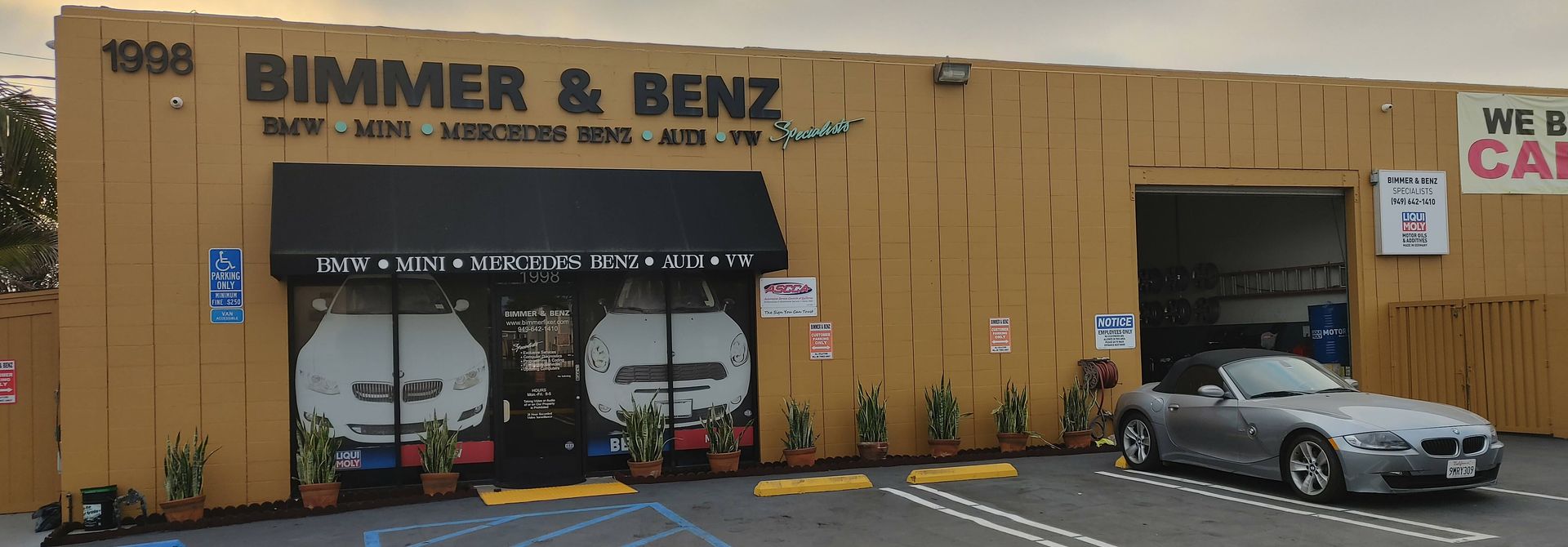
Bimmer & Benz Specialists

Specializing in the repair and service of BMW, MINI, and Mercedes

Bimmer & Benz Specialists - Specializing in the repair and service of BMW, MINI, and Mercedes

Suspension Service At Bimmer & Benz Specialists


  />  

Suspension systems will continue to operate effectively for many years and tens of thousands of miles. Eventually sedan components do wear out, but how long that takes depends a lot on how you drive in Sunset Beach.

As you can imagine, if most of your driving is on smooth California highways, your shock absorbers will last a lot longer than if you do most of your driving on bumpy roads or hauling heavy loads. In addition to just wearing out, sedan suspension components can be damaged in an accident or by a hard impact – like a pothole, hitting a curb or a rock in the road. Because the life span of shocks can vary so widely, your sedan manufacturer recommends periodic inspections.

Suspension Service At Bimmer & Benz SpecialistsDuring an inspection at Bimmer & Benz Specialists, your friendly Sunset Beach service technician will check for worn, broken or missing parts. Let me give a rundown of the major suspension components.

First there are the springs. The springs hold the weight of the vehicle. There are several kinds of springs. Springs are obviously heavy duty parts that rarely break or wear out. Shock absorbers work in conjunction with springs to smooth out the ride and help keep the tires on the road. The shocks are key to handling performance and ride comfort.

You’ve probably heard of struts. They combine a shock absorber and a coil spring in one unit. Shocks and struts will wear out over time. There are some signs that shocks or struts are wearing out. The tires may have a cupped wear pattern. This is from the shocks bouncing unevenly. You may notice a floaty or drifting sensation when cornering. If the front of your sedan dives excessively when stopping, or rocks back and forth after you stopped, your shocks may be worn out. And if they are leaking fluid, it’s definitely time to replace them.

If you are experiencing any of these symptoms, visit Bimmer & Benz Specialists for a suspension inspection. Same if you’ve been in an accident that involved one of your wheels. If your sedan suspension actually fails, it could lead to a serious accident, so take care of these things.

When you replace your shocks, it’s usually a good idea to replace all four at the same time. That’ll give you more even handling. Talk with your Bimmer & Benz Specialists service advisor because you don’t want a big difference between the performance of your shocks from wheel to wheel, and replacing all may be the safest bet.

There different grades of shocks and struts. You always want to use a replacement shock or strut that equals the one that came as original equipment when your sedan was new. But remember, they were designed to meet the expected needs of the broad range of Sunset Beach people who buy that particular vehicle. Your needs may be more specialized.

For example if you want increased handling performance for your sedan, your friendly Bimmer & Benz Specialists advisor can recommend an upgraded shock or strut to give you what you want. If you haul heavy loads or trailers, you can get a more heavy duty shock absorber.

Battery Replacement For Your sedan

Modern cars and trucks in and around Sunset Beach run on 12 volt electrical systems. 12 volts is enough to get the job done without having so much power that there is danger of electrocution. But today’s vehicles have more electrical components and do-dads than ever before. This really strains your electrical system, making it hard for the battery to keep up. Think about it: electric seats, seat heaters, power locks, windows and sun roofs. And then we have all the power outlets for our cell phones, computers, and DVD players.

We also have navigation systems and powerful stereos. Plus there are all the engine and transmission computers, traction control, stability control, anti-lock brakes, sensors and on and on. Even the security system is running off the battery while the car is turned off.

Fortunately, battery technology has given us resilient batteries that are able to meet these strenuous requirements. But the fact is, batteries just wear out over time. Eventually, every battery gets to the point where it cannot hold enough of a charge to start your car. Sometimes batteries need to be replaced because they have just worn out. Or, in other cases, they have developed a leak and need to be replaced.

Special safety precautions are taken when working with batteries in the shop at Bimmer & Benz Specialists in Costa Mesa California. These precautions also apply to anyone who is poking around the battery. Batteries contain sulfuric acid that can damage your eyes and burn your skin, so safety glasses and rubber gloves are a must. Be careful to not spill acid on your clothes or the vehicle’s paint. Of course, avoid short circuiting the battery as well.

Replacement batteries come in all shapes and sizes. Some cars have limited space that requires a specially shaped battery to fit. Larger engines require more powerful batteries to get them started. If you live in a cold climate you will need a more powerful battery because engines are harder to start when it is cold.

Sometimes there is quite a price range for batteries that will work in a particular car. Think of it as “good”, “better” and “best”. More expensive batteries have a longer warranty and are guaranteed to last longer. As with most things, paying a little more up front saves money in the long run.

Bimmer & Benz Specialists
1998 Placentia Ave
Costa Mesa, California 92627
(949) 579-2768

Bimmer & Benz Specialists Radiator Service

The coolant system is a vital part of your vehicle. It is also the second most common cause for vehicle failures. Even though coolant system failure is fairly common, it is easy to prevent.

Bimmer & Benz Specialists
1998 Placentia Ave
Costa Mesa, California 92627
(800) 639-9078

The most recognizable part of the coolant system is the radiator. It is connected to the engine with hoses and is filled with coolant. The coolant draws heat off the engine and then goes into the radiator. Air passes through cooling fins to reduce the temperature of the coolant and then it’s back to the engine again.

There are several ways for the cooling system to fail. Most common is with the coolant itself. Coolant is a mixture of water and antifreeze. The proper mixture keeps the coolant from either boiling away or freezing. Both of which can result in massive engine damage.

Another very important coolant issue that is often overlooked is the age of the coolant itself. Antifreeze has additives that protect the coolant system from corrosion. As these additives are depleted over time, they can’t protect the radiator and other parts from rust, scaling and corrosion. Old coolant may still keep your engine cool, but it won’t protect it from corrosion.

If you see a warning message to check the coolant or if the temperature gauge is in the hot zone your cooling system needs to be checked. It’s OK to add water or antifreeze yourself. But you need to be cautious. Remember four things.

  • First, you never want to open the radiator pressure cap. You could be severely burned.
  • Second, try to get to your Costa Mesa service center at Bimmer & Benz Specialists immediately if your coolant is low. If that is not possible, follow the directions in your owners manual – it will direct you to only make additions to the coolant overflow bottle.
  • Third, remember that you need a proper mixture of water and antifreeze. If you make an emergency addition to your cooling system, follow-up with your Bimmer & Benz Specialists service center where we can make necessary corrections.
  • Fourth, not all cars use the same type of antifreeze. You need to check your owners manual to make sure you use the right kind. Mixing antifreeze types or using the wrong kind of antifreeze may void the manufacturers warranty on your cooling system. Again, another reason to rely on your Bimmer & Benz Specialists service center in Costa Mesa to do things right.

Remember, your Costa Mesa service center has the equipment to change your coolant quickly and inexpensively.

Trip Inspection

North Americans love their cars. And nothing goes with cars better than the road trip. Freedom from daily schedules, new sights and the open road – it’s great! But there’s nothing like car trouble to bring the fun to a grinding halt.

Now you can’t always avoid problems, but you can take steps to reduce the probability of getting sidelined on your trip. The first step is to look at your trip plan from your vehicle’s perspective. What kind of roads will you be traveling – winding byways or super-highways? Mountains or plains? What weather conditions are you likely to encounter? How many miles will you travel? How much weight will you be hauling – passengers and luggage? Lugging a trailer or roof top carrier? Will it be dusty?

Armed with the answers to these questions, you can start a trip inspection to help you prepare your Costa Mesa vehicle for your big adventure. A lot of our Costa Mesa customers prefer to go through this exercise with an automotive service advisor at Bimmer & Benz Specialists to get their input and make sure they haven’t left anything out.

A great place to start is with the tires. Inspect them for tread wear and proper inflation. Is it time to rotate your tires? Replace them? Are they up to the job – you wouldn’t want to drive regular highway tires on a muddy off-road adventure.

Shocks and struts play a major role in both driving comfort and safety. If they need to be replaced, you’ll really be glad you did once you hit the road. Is it time for a wheel alignment? Fighting a car that’s pulling to one side all day can be tiring and dangerous.

And don’t forget your brakes. Any strange noises, grabbing, soft or hard peddle feel? If there is any doubt, get a brake inspection before you leave.

Moving under the hood, have your belts and hoses inspected. If something is excessively worn or near failure, the stress of a long road trip might just be the straw that breaks the camel’s back.

Your engine air filter will be important. For every gallon of gas you burn, your car will filter and use 12,000 gallons of air. If the filter needs to be changed, you’ll notice the fuel savings on your trip.

How close are you to your next oil change? Will you be able to complete your trip before it’s due? If not, just get it taken care of before you go so that you don’t need to interrupt your trip. In fact, a full service oil change is a great idea because they will top off all your fluids and check to see if any other maintenance items are due, such as transmission or cooling system service.

Do you notice any unusual odors in your vehicle? If so, it could as harmless as a dirty cabin air filter. But if it’s an exhaust leak it could be fatal on a long trip. Of course you’ll want to be comfortable, so get an air conditioning service if you aren’t getting the cold air you used to.

Are you wiper blades still working well? If not, that is quick and inexpensive to fix. Headlamps are often overlooked when planning for a trip. If you haven’t changed the bulb in six months or so, replacement bulbs will really light up the night on your trip.

All the items mentioned are part of any good vehicle maintenance plan. These are things that you want to take care of anyway, but they all come into focus as you plan for your trip.

They will always save you money in the long run and may prevent inconvenient delays on your trip. After all, you wouldn’t want to miss the world’s largest ball of string, would you?

Fuel Injectors

The last new car sold with a carburetor in North America rolled out of the dealership in 1990. Since then, all new vehicles have had fuel injectors. In very simple terms, a fuel injector is a valve that squirts fuel into your engine. Your engine control computer tells the fuel injector how much gas to deliver as well as the precise time it should be delivered. Of course this happens thousands of times a minute. Fuel injection is a much more precise way of delivering fuel than carburetors. That translates into better fuel economy and power. Virtually all fuel injectors for gas engines are known as port fuel injectors because they deliver the fuel to a port just outside the cylinder. Port fuel injectors operate at about 40 to 80 pounds per square inch of pressure.

A few auto makers have introduced gas direct injection systems on some engines recently. These systems inject the gas directly into the cylinders under very high pressure – hundreds of times the pressure of port injection systems. Although more complicated, direct injection technology promises greater power with improved fuel economy, so we can expect to see more of it in the future.

As you can see, the level of precision required of your fuel injectors is very high. They need to be operating properly in order for your car to run right.

High temperatures under your hood and variations in gas quality cause fuel injectors to become fouled with wax, dirt, and carbon. Injectors can become partially clogged, preventing them from delivering the proper amount of fuel at the correct pressure. The design of each engine requires a specific spray pattern from the fuel injector that might be altered when the injector is dirty. When injectors are dirty, the fuel doesn’t burn as efficiently resulting in poor fuel economy and loss of power. So it is important to keep your fuel injectors clean.

Skilled service technicians at Bimmer & Benz Specialists in Costa Mesa can perform a fuel system service for you. (Visit http://www.bimmerfixer.com/contact.html.) That is a fuel system service – not just fuel injector cleaning. That is because the fuel has a lot of ways to become dirty or contaminated between the gas tank and the fuel injector. A fuel system service starts with a fuel filter replacement. This filter cleans the gas as it leaves the tank. The various parts of the fuel intake system need to be cleaned from time to time to remove harmful gum, deposits and varnish. Finally, the fuel injectors are cleaned so that they operate properly and deliver the right amount of fuel at the right time.

Your Huntington Beach area service center uses a process for cleaning your fuel system that includes state-of-the-art cleaning chemicals as well as some old fashioned scrubbing. Proper maintenance of your fuel system means that you will spend less on gas, enjoy strong performance and prevent costly repairs down the road.

Suspension Service In Costa Mesa California

When you hear the word ‘suspension‘, you may think back to those energetic days of grade school. Well, your car’s suspension is actually a good thing because it keeps your car up off the road and helps provide a comfy ride. It needs to keep your wheels firmly planted over bumps and through curves. Your suspension system has many parts. If you look under your car, it’s basically everything that connects your wheels to the car’s frame. These are heavy duty parts that do a lot of work. They need to be inspected for damage and excessive wear at least once a year. A good time for this is when you get your annual alignment service.

Here are some warning signs that your suspension may have problems:

  • the car pulls to one side;
  • it wanders;
  • the steering is erratic;
  • you see uneven tire wear;
  • you experience a poor ride or handling;
  • you see oil leaking from shocks

. . . You just don’t feel in control when you’re driving.

Some suspension parts just wear out with use. Shocks and struts eventually lose their ability to control your ride. Wheel bearings need to be repacked every couple of years. And some suspension pieces need to be lubricated when you get your oil changed. Your service advisor at Bimmer & Benz Specialists can oversee an inspection and tell you what problems you may have.

If you’re in an accident, your suspension can be damaged or knocked out of alignment. Even a minor accident, like hitting a curb around Costa Mesa or even a large rock can mess things up. With a minor accident it’s tempting to just get an alignment or wheel balance to correct the problem. But if there’s some damage, a simple alignment won’t actually fix the problem, and you’ll just have to align it again after the repairs are made. So if you have an accident, get your suspension system inspected right away. Suspension problems should be fixed immediately because they can lead to unsafe handling.

One big cause of suspension damage is potholes – those nasty magnets that seem to draw our tires right into them. Well, Here are some tips for avoiding damage from potholes: First, keep your tires at their full air pressure. That gives tires their maximum resiliency and will hopefully keep your wheels or other suspension parts from crunching on a big hole. Next, just pay attention. When you see a hole you can’t miss, slow down before you hit it. Driving at a slower speed will limit the damage, and may keep your drink from spilling. But don’t brake directly over the pothole. That will cause the car’s weight to shift forward and add to the potential damage.

Bimmer & Benz Specialists
Give us a call today at (800) 639-9078.
Or stop by at 1998 Placentia Ave, Costa Mesa, California 92627

PCV Valve Replacement

The energy from exploding fuel is what powers your engine. But some of the vapors from the explosions escape into the lower part of the engine, called the crankcase. The crankcase is where your engine oil hangs out. These gases are about 70% unburned fuel. If the gases were allowed to stay in the crankcase, they would quickly contaminate the oil and turn it to sludge. Sludge is one of the biggest enemies of your engine, clogging it up, eventually leading to expensive failures. Also, the pressure build up would cause seals and gaskets to blow out. Therefore, these gases need to be vented out.

Gasoline engines used to simply have a hose that let the poisonous fumes vent out into the air. In 1963, the federal government required gas engines to have a special one-way valve installed to help reduce dangerous emissions. Diesel engines are not required to have these valves.

The positive crankcase ventilation, or PCV, valve routes crankcase gases through a hose and back into the air intake system where they are re-burned in the engine. Fresh, clean air is brought into the crankcase through a breather tube. It’s really a pretty simple system, but does an important job. The re-circulating air removes moisture and combustion waste from the crankcase, preventing sludge. This extends not only the life of your oil, but the engine as well. The PCV relieves pressure in the crankcase, preventing oil leaks.

Eventually, the PCV valve can get gummed up. Then it can not move enough air through the engine to keep it working efficiently. If the PCV valve is sticking enough, you could have oil leaks, excess oil consumption and a fouled intake system. If you experience hesitation or surging or an oil leak, it may be a sign of PCV value problems. Your owners’ manual may give a recommendation for when the PCV valve should be replaced – usually between 20,000 mi/32,000 km and 50,000 mi/80,000 km. Unfortunately, some manufacturers don’t list a recommendation in the manual, so it can be easy to overlook.

Many PCV system problems can be diagnosed with a visual inspection. Fortunately, PCV valve replacement is both quick and inexpensive. Proper oil changes will greatly extend the life of the PCV valve. Skipping a few recommended oil changes can allow varnish and gum to build up in the valve, reducing its efficiency. So now when your Costa Mesa service technician tells you its time to replace your PCV valve, you will know what he’s talking about. If you have had your car for a while and this is the first you’ve ever heard of a PCV value, ask your tech to check yours out or call Bimmer & Benz Specialists at (800) 639-9078.

Exhaust Service

Whenever we talk about exhaust service, most people normally think about exhaust pipes and mufflers. Well, actually, exhaust service is a lot more comprehensive these days. For example, catalytic converters were mandated in 1976 and on-board emission control computers in 1990. Governmental emissions requirements have forced manufacturers to come up with much more sophisticated ways to comply with environmental regulations.

Exhaust service has really become exhaust and emissions service. High-tech computer controlled emissions devices are now a big part of exhaust service. Because it is so sophisticated, your vehicle manufacturer recommends you have your emission system checked out by a qualified Costa Mesa exhaust technician regularly to make sure everything is working right – usually every 6 months or 10,000 miles/16,000 kilometers.

If your Check Engine light comes on, especially if it’s flashing, get your car looked at right away. Technicians at Bimmer & Benz Specialists handle emission problems everyday. You might have exhaust or emissions trouble if your car is difficult to start, runs rough, is noisy or smoking. Call Bimmer & Benz Specialists at (800) 639-9078 to schedule an appointment if you experience these problems.

Let’s review the exhaust system. We will start from the top and start with the exhaust manifold. That is the part that attaches to the engine and collects the exhaust from the cylinders and directs it into the exhaust pipe. Exhaust gaskets help seal the connection with the manifold and various other joints along the way. If the manifold is cracked or loose, or a gasket is leaking, dangerous gases could escape into the passenger compartment, where you ride. Carbon monoxide can be deadly, so it is important that your exhaust system doesn’t leak. The exhaust pipes connect the various components. They can rust or be damaged by a rock, so they need to be inspected periodically.

Next is the catalytic converter. This part looks like a muffler. It changes chemicals that are dangerous to your health and the environment into harmless carbon dioxide and water. It doesn’t require any maintenance itself. But eventually they wear out. You will find this out when your car fails an emissions inspection.

Now the muffler. Its main job is to quiet engine noises. Mufflers work by either absorbing or baffling sound. And you can actually customize your car’s sound with different mufflers – anything from whisper quiet to bad-boy rumbley. Rusted or road-damaged mufflers can leak and need to be replaced right away.

The exhaust system is attached to the car by a series of hangers and clamps. These fasteners hold the system in place. When hangers come loose or break, hot exhaust components can touch and melt wires, hoses and lines.

Finally, we end at the tailpipe. This is the final outlet for the exhaust. These can be plain-Jane or pretty flashy. Also, the oxygen sensors monitor the oxygen content of the exhaust so the engine control computer can adjust the fuel-to-air mix to keep the car running right.

Exhaust and emissions service covers plain old pipes and high-tech computers. It impacts everything from life and death safety due to exhaust leaks, to fine-tuning the sound of your ride.

Power Steering Service Near Newport Beach

For most of us living in the Newport Beach area, it is hard to remember life without power steering – cranking those great big steering wheels? It was a pretty good workout. Now power steering is standard. The heart of any power steering system is its pump. The pump pressurizes the power steering fluid that provides assist for steering. Most pumps are driven by a belt that is run by the engine – a few are electrically powered. A high-pressure hose passes fluid from the pump to the steering gear. A low pressure hose returns the fluid back to the pump.

These hoses can develop leaks, so it is a good idea to inspect them at every oil change. Low fluid can damage the power steering pump. That is why fluid level is on the checklist for a full-service oil change. The fluid needs to be compatible with the hoses and seals, so check your owners’ manual for the right type – or just ask your service technician at Bimmer & Benz Specialists.

The fluid cleans, cools and lubricates the power steering system. It breaks down as the years go by and collects unwanted moisture, so it needs to be replaced from time to time. Many manufacturers specify power steering service intervals. Unfortunately, this important service is sometimes left off the maintenance schedule for many of us in Newport Beach. So, when in doubt, every 25,000 miles/40,000 km or two years is a good fallback. Your Bimmer & Benz Specialists service center in Newport Beach will use a detergent to clean the system, flush out the old fluid and replace it with the good stuff.

Here are some warning signs of trouble with your power steering: It’s harder to turn the wheel, there’s erratic power assist, you hear loud whining coming from the pump (which may be difficult to hear over the loud whining coming from the backseat), you have to top-off the fluid frequently, or you hear squealing belts. Remember to never hold the steering wheel to the far right or left for more than a few seconds at a time. That will wear out your power steering pump real fast.

Other steering components can be bent or damaged from wear or hard knocks. Ball-joint, idler-arm, steering-gear, steering-knuckle and tie rod to name a few. Warning signs here are steering play, wandering, uneven tire wear, and off-center steering wheel. An annual alignment check at Bimmer & Benz Specialists will reveal bent or damaged steering components.

Most SUV’s, pick-ups and rear-wheel-drive cars need regular front-wheel-bearing service.

The bearings should be cleaned and inspected. If they are excessively worn, they need to be replaced. The bearings are then repacked in clean grease. It’s also recommend the wheel-seal be replaced when the bearings are serviced. Like everything else, check your owners’ manual maintenance schedule. It’s usually required around every two years or 40,000 miles/64,000 km. If you drive through water in the Newport Beach area, the bearings will need service more often.

Bimmer & Benz Specialists
1998 Placentia Ave
Costa Mesa, California 92627
(800) 639-9078

Severe Service Requirements

A lot of our viewers have asked whether or not they should use their severe service maintenance schedule, which is listed in their car owners’ manual. It can be confusing. Let’s clear the air on this subject. Cricket Killingsworth is from QMI/Heartland, a manufacturer of automotive products and fluids. She’s been in the automotive business for 20 years and is a speaker, a trainer, and a writer. Cricket says there’s so much confusion on this topic because, “Most owners’ manuals actually have two maintenance schedules. Sometimes these are called ‘regular service’ and ‘severe service’. Sometimes they’re simply called Schedule 1 and Schedule 2. A severe service schedule recommends that things like an oil change, air filter replacement, and transmission service be done more often: either in fewer miles or in less time.

Manufacturers create these specific schedules for each vehicle they make. So there isn’t one generic schedule that applies to all cars. In addition to your owners’ manual, Costa Mesa automotive repair centers subscribe to information services that provide the maintenance schedules for every vehicle – so they can help you know when to take care of needed services. Below is a typical definition for severe service.

  • Most trips are less than four miles
  • Most trips are less than ten miles and outside temperatures are below freezing
  • You drive in very hot weather
  • The engine is at low speed most of the time (not on the highway)
  • Stop and go driving
  • You operate your vehicle in dusty or muddy conditions
  • You tow a trailer, regularly carry heavy loads or carry a car-top carrier

It’s common sense: Just a few minutes at freeway speeds allows the moisture in the oil to evaporate. Very short trips, or trips of less than ten miles when it’s very cold, don’t allow the engine to heat up enough to get rid of the water. And water in the oil leads to damaging sludge. Also, towing and heavy loads raise operating temperatures and cause fluids to breakdown more quickly. Dusty and muddy driving means that more dirt will get past the air filter to contaminate the fuel system and engine oil.

The bottom line is that you need to decide for yourself if the regular or severe service schedule is right for you, based on your driving. Look at your owners’ manual, or talk with your Bimmer & Benz Specialists service advisor who can help you know which schedule to follow. Bimmer & Benz Specialists is located at 1998 Placentia Ave, Costa Mesa California.,

Here is what a fleet manager said recently: “Since city miles are generally tougher on vehicles than highway miles, we use the manufacturer’s severe service schedule as the basis for our preventative maintenance program. We massage those schedules over time, increasing or decreasing the service intervals so that they make the most sense. There is a little bit of art to go along with the science.

Make an honest evaluation of your driving habits. Unless you do mostly California highway driving in moderate weather, you’ll likely have a fairly good amount of severe service mixed in. Some people just want to play it safe and follow the severe service recommendations, rather than analyzing how they drive each month.